
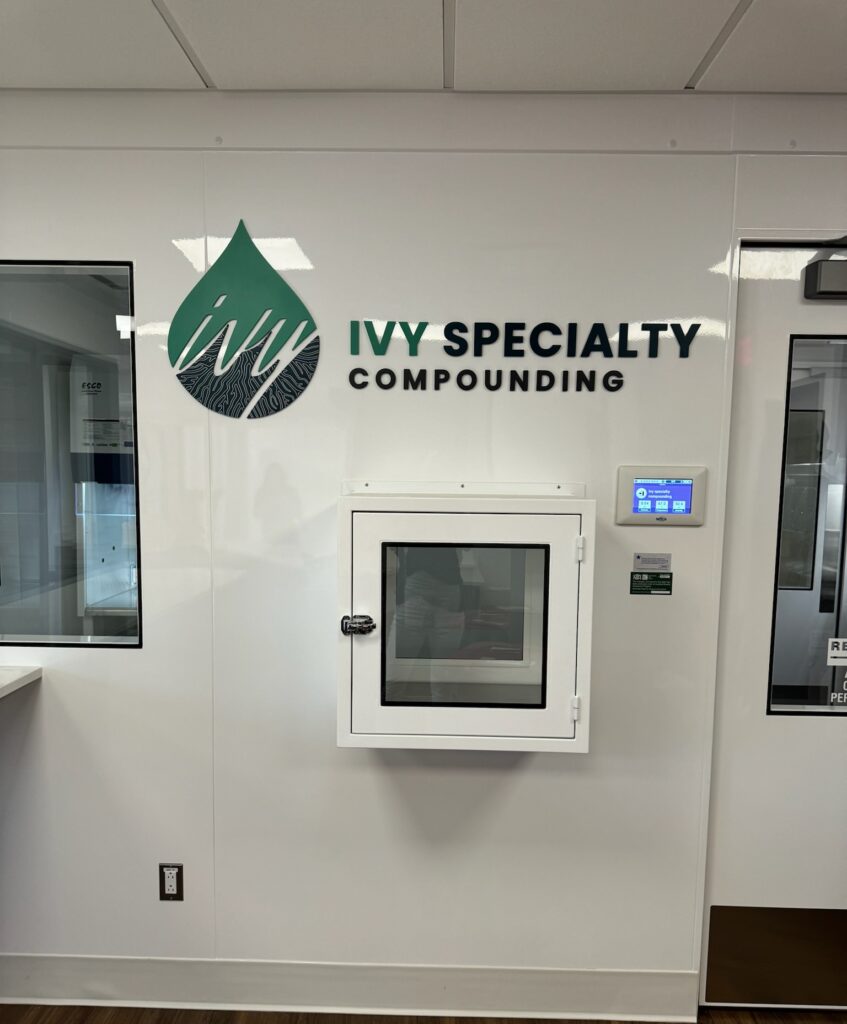
When we made the decision to invest the time, resources, and expertise required to build a sterile compounding cleanroom, it wasn’t just about meeting regulations or compounding standards—it was about meeting the needs of our community.
Our goal was to be able to offer any pharmaceutical product necessary to ensure access to care. Many of these therapies are often difficult to obtain outside of hospital systems, and we believe our community deserves a simpler, more accessible option.
Ivy’s cleanroom allows patients to obtain safely compounded medications without traveling long distances or navigating complex hospital processes. Facilities like this are most commonly found in hospitals, making our pharmacy’s cleanroom truly one of a kind in a community setting.
Equally important to us is transparency. We believe patients and providers should feel confident knowing exactly how medications are prepared. By investing in a cleanroom built to the highest national standards, we can openly stand behind the safety, quality, and precision of every sterile product we compound.
What Is a USP <800> and USP <797>-Compliant Sterile Compounding Cleanroom?
As compounded medications become more complex and personalized, safety standards in pharmacy have evolved to protect both patients and healthcare professionals. Two of the most critical standards governing sterile compounding today are USP <800> and USP <797>.
A USP <800>– and USP <797>–compliant sterile compounding cleanroom is a specially designed, highly controlled environment where sterile medications—both hazardous and non-hazardous—are prepared safely, accurately, and in full compliance with national guidelines.
Understanding USP <800>
USP <800> is a chapter published by the United States Pharmacopeia that establishes standards for handling hazardous drugs in healthcare settings. Its primary goal is to minimize exposure risks to pharmacists, technicians, patients, and the environment. These standards apply to all facilities that receive, store, compound, administer, or dispose of hazardous medications, including chemotherapy drugs and certain hormones, antivirals, and biologics.
When sterile hazardous drugs are compounded, the requirements become even more stringent, making the cleanroom a critical component of compliance.
USP <800> focuses heavily on containment, airflow control, personal protection, and environmental safety, ensuring hazardous drug particles do not escape into surrounding areas.
Understanding USP <797>
While USP <800> addresses hazardous drug safety, USP <797> establishes the standards for sterile compounding itself.
USP <797> is designed to protect patients by ensuring that compounded sterile preparations are:
- Free from contamination
- Accurately prepared
- Consistent in strength and quality
- Made under controlled environmental conditions
- This guideline governs everything from air quality classifications and environmental monitoring to aseptic technique, staff training, cleaning procedures, and beyond-use dating. In short, USP <797> defines how sterile medications must be compounded to maintain patient safety and medication integrity.
Together, USP <797> and USP <800> work hand in hand—one protecting the patient, the other protecting both the patient and the healthcare team.
What Is a Sterile Compounding Cleanroom?
A sterile compounding cleanroom is a highly controlled space designed to limit particulate matter, microorganisms, and contamination. These cleanrooms are built to meet specific air quality classifications, pressure differentials, temperature, and humidity standards.
In a USP <797>–compliant cleanroom, air is continuously filtered to maintain an environment suitable for sterile preparation. In a USP <800>–compliant setting, the cleanroom must also be designed to contain hazardous drug particles and vapors, preventing them from migrating to other areas of the pharmacy.
Key Features of Ivys’ USP <800> and USP <797>–Compliant Cleanroom
One of the most important elements of hazardous sterile compounding is negative pressure. USP <800> requires that areas where hazardous drugs are compounded maintain negative pressure relative to adjacent spaces. This ensures airborne contaminants remain contained within the cleanroom.
High-efficiency particulate air (HEPA) filtration systems are another essential feature. These systems continuously filter the air to remove particles and microorganisms, supporting the sterility requirements outlined in USP <797>.
Workflow design is also critical. Ivy’s cleanroom includes clearly defined areas for hand hygiene, gowning, compounding, and waste disposal. Personnel, materials, and waste move through the space in a controlled, unidirectional flow to reduce contamination risk and maintain compliance with both USP chapters.
Why Sterile Compounding Processes Matter
Sterile compounding is not simply mixing medications—it is a highly controlled, precision-based process that directly impacts patient outcomes.
Strict adherence to USP <797> ensures that injectable and infused medications are prepared using aseptic technique, reducing the risk of infection, contamination, or compromised drug stability. For patients receiving sterile medications, these processes are critical to safety and effectiveness.
At the same time, USP <800> protects pharmacy staff and the environment from hazardous drug exposure, reducing long-term health risks and maintaining a safe workplace.
A USP <800>– and USP <797>–compliant sterile compounding cleanroom represents the highest standard of safety, quality, and accountability in modern pharmacy practice. Through controlled environments, specialized equipment, and rigorous processes, these cleanrooms protect patients, healthcare workers, and the integrity of the medications themselves.
As personalized, injectable, and hazardous therapies continue to grow, cleanrooms like ours play an essential role in ensuring access to safe, reliable care within the community.